
Objectives
Principal aim
The principal aim of the research proposed herein is to establish an unprecedented protocol to tackle this very problem of Mycenaean vitreous materials retrieved in archaeological excavations and stored lacking proper identification (either interchangeably or even seen as ceramic or stone) and preventive conservation practices, failing, thus, to be classified, interpreted, reconstructed and studied successfully; the latter also imposing risks for their future preservation. The novel approach proposed herein aims at applying state of the art X-ray technology to accomplish the following objectives:
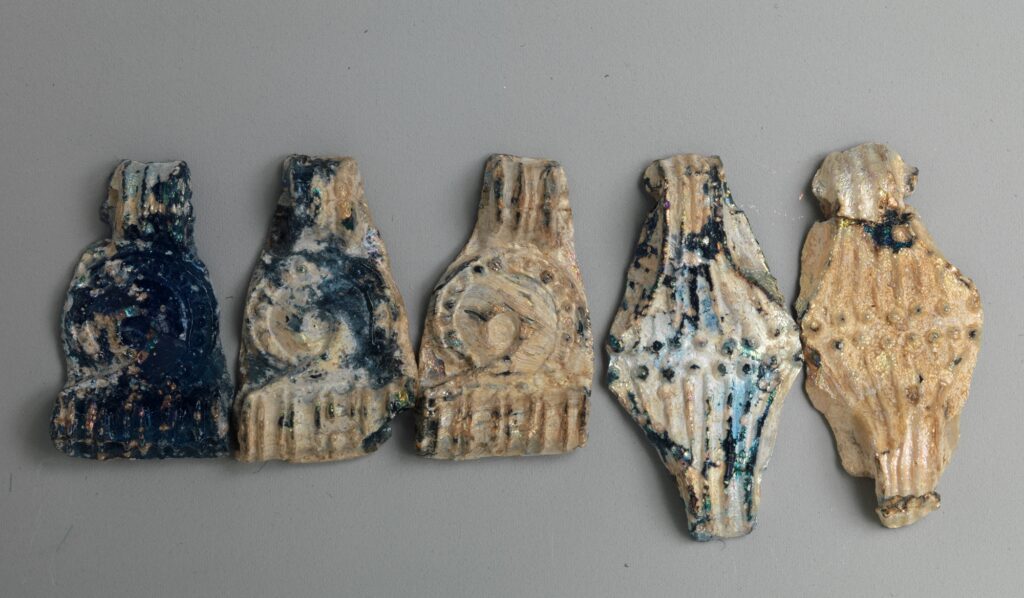
Objectives
1) To offer the academic community a tool for safe taxonomy of vitreous materials compiled by the generation of a systematic set of visual corrosion-related characteristics towards successful taxonomy of vitreous materials.
2) To investigate a broad compilation of Mycenaean vitreous objects by performing holistic examination by means of non-invasive, well- established and state-of-the-art scientific methods, challenging all the possibilities offered, in order to analyze, document and identify the specific compositional changes that occur due to degradation mechanisms at different spatial dimensions, within the surface, near-surface layers, but also in-depth, to propose firm associations of the analytical data with the observed visual characteristics of the materials.
3) To reclaim the systematic data generated via the application of scientific methods, regarding the chemical composition of Mycenaean vitreous materials, towards addressing provenance issues and evaluating the manufacturing technology within the corpus of the examined Mycenaean artefacts.
4) Since the compositional data required to address the principal aim of this research will comprise a robust analytical data bank, the study aspires to yield plausible answers to an array of archaeological questions, bringing to light key information on the ancient craftsmen practices, technical skills and aesthetics, as well as on ancient cultures economy, trades and religion. Encapsulating the expertise of researchers from an array of scientific fields, the study aims to develop analytical science-driven and archaeology-driven research themes and metastudies, propelling the current science-based research on vitreous technology onto a new level of enquiry.